Whitepaper · Physical AI · Teleoperation data
A hundred humanoids are about to learn from people. Give them eyes that keep up.
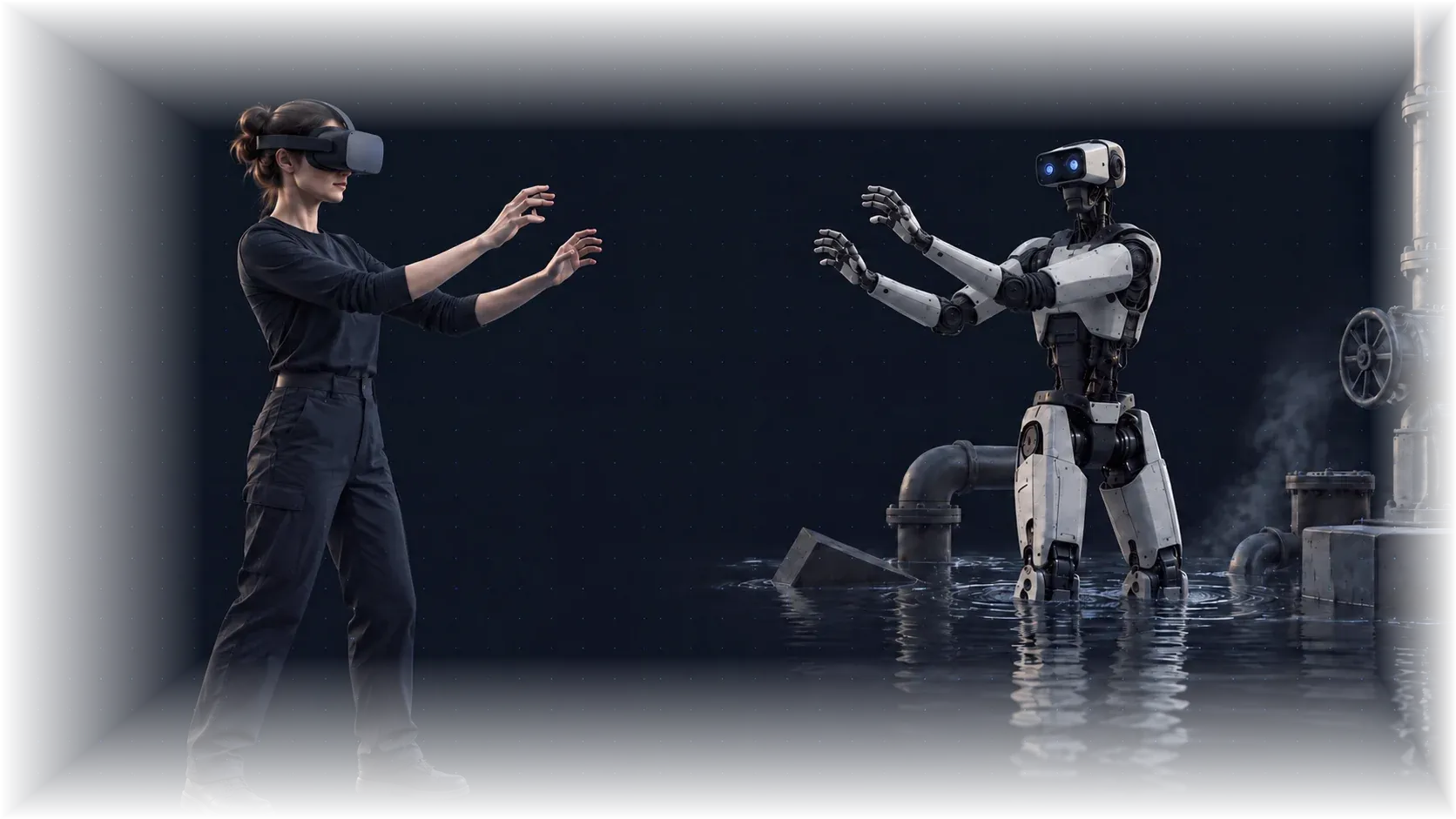
OpenIPC brings the open, ultra-low-latency video stack proven in FPV to human-in-the-loop robotics: a rig that fits any robot from any maker, a link that never stalls, every frame stamped the instant it is captured, every session a dataset.
Market figures: KeyResearch, September 2026. Latency: figures reported by people flying the stack, on the low-latency page.
The data strategy is settled. The rig is not.
Everyone building a general-purpose robot has picked a way to get training data. Figure bets on human video, Tesla on simulation, 1X and Unitree on human-in-the-loop teleoperation: a person drives the robot, the session is recorded, and a policy is trained on data that is already kinematically correct for that body. Amazon's research teams take the other road, translating human motion capture into robot motion after the fact.
Teleoperation is winning because it closes the embodiment gap at the source. Unitree alone has built some 18,000 bipeds, and every one of them is going to be driven.
What is not settled is the rig. Unitree's avatar drives Unitree's robot. The other 43 makers on the list, and every lab with more than one kind of machine, need a teleoperation and data rig that fits any robot and any camera.
And it has to answer the one question demo videos never do: what is the glass-to-glass figure, and how was it measured? The operator can only be as good as the delay they feel, and the dataset inherits every hesitation.
Latency is a tax on every episode you record.
What OpenIPC brings to the loop
Four things, each already running on cameras in the field.
Tens of milliseconds, proven in the air
The same stack FPV pilots fly at full speed, on cameras that cost less than lunch. Open firmware from the sensor to the encoder, tuned for the shortest way out.
A link that drops a frame, not the operator
Video down, control up, and no stall in between: no pairing, no retransmit queue. When the air gets noisy you lose a frame, never the robot.
Time built into every frame
Each frame is stamped the instant the sensor captures it, before anything else touches it. Every camera on the robot agrees to within a few milliseconds, with no trigger cable, so the dataset lines up.
Record everything, send what fits
One encoded stream, two speeds. The recorder keeps every frame while the operator's link carries what it can — no second encoder, no second camera.
From the operator's hands to the training set
Teleoperator is the layer we are building on top of the stack: a human-in-the-loop rig for any robot — humanoid, wheeled or flying — piloted from a headset, with every session written as LeRobot datasets the open robotics community already trains on.
Operator
Sees what the robot sees; head, hands or whole body tracked
Link
Video down, intent up
Robot
Any maker's: arms, legs, wheels or rotors
Recorder
Every frame, every pose, one clock
Dataset
Episodes ready to train on
The policy trained on the dataset drives the robot next. That is the flywheel.
What a pilot looks like
Eyes on the robot
OpenIPC firmware on the cameras your robot already carries, and the link between the robot and the operator's station.
Hands on the controls
An operator drives the machine: head and hands from a headset, or the whole body from a motion-capture suit, mapped onto the robot's own joints, with a failsafe that stops it the moment the link goes quiet.
Sessions into datasets
Folding laundry, loading a fridge, tidying a room: every run is recorded on one clock — what the operator saw, what they did, what the robot felt — as LeRobot episodes, ready to train on.
Why OpenIPC
Open since 2019
Firmware and tools for dozens of camera chip families, in the open, with a community that reads the source and fixes what it finds.
Proven in the air
FPV pilots fly the stack every day, and RunCam and other vendors ship OpenIPC-based hardware out of the box. The reflexes that fly a drone through a gap are the ones that box a robot in a ring, and the link has already been through the worst radio conditions there are.
Not tied to a robot maker
No cloud, no subscription, no per-unit tax, and no dependency on whose robot you bought. When a chip goes end-of-life, the firmware outlives it — and so does your robot.
Bring a robot, whoever made it. We bring the eyes.
We are taking three design partners: a robot, a bench and an engineer on your side; camera firmware, the link and our time on ours. What comes out is a teleoperation loop measured on your machine — and, if you want it, your first dataset.
Write to business@openipc.org Ask in the chat
An engineer answers, not a sales script. Camera and link engineering that ships today is on the business page.